
Questions & Answers
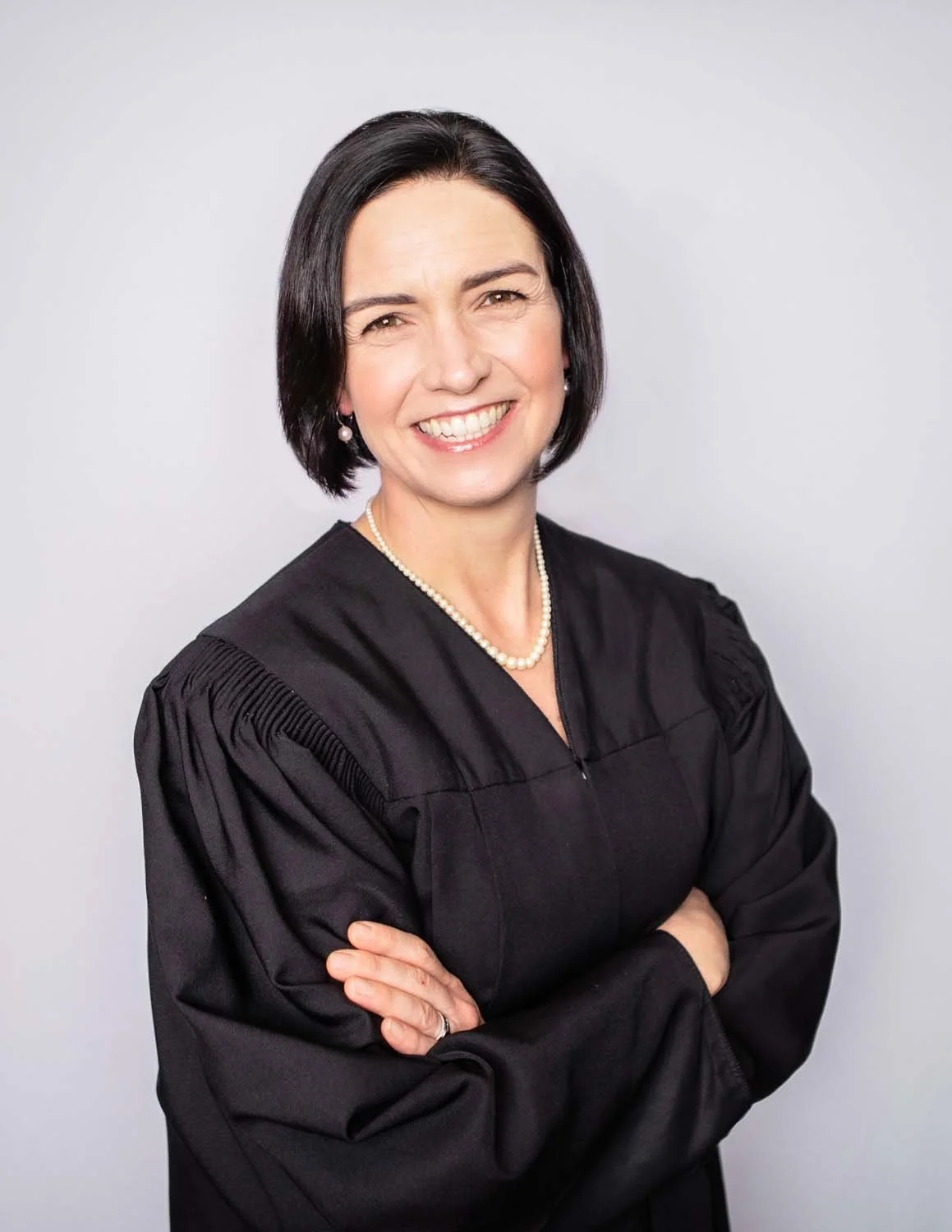
A Letter from Judge Brown
Hi there,
I wanted to write to you directly. A voter pamphlet line or a newspaper headline can only tell you so much about a judge, and this is one of those races where a few headlines have done most of the talking.
Most people do not think about their circuit court judge until they need one. By the time you do, whether it is a custody case, a landlord dispute, a criminal matter, a protective order, or something involving someone you love, you are already having one of the harder weeks of your life. You are not choosing your judge that day. You chose them years earlier on a ballot, probably without as much time to research as you wanted.
I ran for this seat in 2020 because I wanted to be the judge I would want standing between me and the hardest day of my life. Someone who knew the law. Someone who took the person in front of her seriously. Someone who understood that the courtroom is often where people first encounter the rule of law, and that it has to work when they get there.
That is what I have done for five years. And it is why the presiding judge of Multnomah County, the chief criminal judge, a former Governor, civil rights leaders, immigrant community leaders, and Disability Rights Oregon are all asking voters to keep me on this bench.
Below are the questions I hear most often, along with a few I know you may have from recent coverage. I wanted to answer them in my own voice.
Thank you for reading.
Adrian
Judge Adrian Brown
Part 1
Questions I Hear Most Often
-
Because I promised voters in 2020 that I would uphold the rule of law, treat every person in my courtroom with dignity, and keep our community safe. I have done that work for five years and I want to keep doing it.
Courts across the country are under real pressure right now. Judges who rule independently face public attacks designed to push them off the law. Experienced, independent judges on the bench are how we protect fair courts for everyone.
-
I have spent more than two decades in public service.
I started in the United States Air Force as a Judge Advocate General officer, serving nearly seven years on active duty in Alaska, Washington, and Germany. I tried more than 40 criminal cases — domestic violence, child abuse, drug offenses, sexual abuse of children, fraud, rape, and negligent homicide. I worked across the Pacific Northwest, through the European region, in Turkey and Afghanistan.
After the military, I spent thirteen years as an Assistant United States Attorney in Portland, focused on civil rights enforcement. I advocated for and created the civil rights program in our U.S. Attorney's Office. That work led the Justice Department to bring me in as National Civil Rights Coordinator, where I helped create more than thirty civil rights enforcement positions in U.S. Attorney's Offices across the country.
While I was in that role, I led the first federal class-action civil rights investigation of the Portland Police Bureau, which exposed a pattern of unconstitutional use of force against people with mental illness and resulted in changes to PPB's crisis response and use-of-force policies. Attorney General Loretta Lynch later presented me with the John Marshall Award — one of DOJ's highest honors for attorneys — for my work on behalf of people with intellectual and developmental disabilities facing employment discrimination.
I also served on the Oregon State Bar Board of Governors.
-
The full range of a circuit court docket: criminal, civil, and family. In more than five years on the bench I have presided over hundreds of cases. Felony crimes involving children. Civil employment discrimination. Contract disputes. Custody matters. Protective orders.
My rulings have been upheld on appeal, including in cases involving the prosecution of child sexual abuse and cases involving violent offenders. The appellate record shows what the headlines do not: the work holds up.
-
I do not think a judge's work ends at the courtroom door. A few of the things I have worked on while serving on the bench:
I helped launch a therapy dog program with Dove Lewis Canine Therapy Team to support child witnesses, victims of trauma, and others facing high-stress legal proceedings. The dogs now serve courtrooms across four counties.
I volunteer with SOAR (Sponsors Organized to Assist Refugees), meeting with refugee citizenship classes to introduce new Americans to the courts and the Constitution.
I have worked with bench, bar, and state leadership to address Oregon's public defender crisis. Access to counsel is a constitutional right, and the shortage is an emergency.
I co-founded the Oregon Attorneys with Disabilities Association to support lawyers with disabilities and advocate for accessibility in the profession.
I have facilitated training for Oregon judges on how to effectively work with court interpreters, so litigants who do not speak English fluently get the same quality of due process as anyone else.
I have presented at the federal level on expert witness law.
None of this is on the ballot. All of it is part of the job as I understand it.
-
Courage on the bench. Compassion in the courtroom.
Courage means applying the law to the case in front of me, not the case someone wishes were in front of me. It means holding the government to the standard the Constitution requires, even when that is unpopular. It means making rulings I can defend on the record.
Compassion means remembering that every person who walks into my courtroom is having one of the harder days of their life. Even when the law requires a hard outcome, the process should leave people feeling like they were heard.
-
I decide on the facts and the law, not on what is politically convenient for any elected official, myself included.
When courts bend to political pressure, the people who pay the price are not the politicians. It is the person without a lawyer. The family without connections. The community that is already hard to hear. Judicial independence is how we make sure the law applies the same way to all of us, and right now it is under more strain than I have seen in my lifetime.
-
No. Never.
-
The people who have watched this work up close.
Former Governor Barbara Roberts. Presiding Judge Judith Matarazzo of Multnomah County. Chief Criminal Judge Michael Greenlick. Former Chief Criminal Judge Cheryl Albrecht. Mental Health Court Judge Nan Waller. START Court Judge Melvin Oden-Orr. Judge Ben Souede. Disability Rights Oregon. Civil rights leaders. Immigrant community leaders. The President of the Islamic Society of Greater Portland. A former Assistant U.S. Attorney. The CEO of Hacienda CDC.
These leaders do not endorse lightly. They are endorsing a record they have watched me build.
-
I slow down. I explain. I make sure they understand what is happening, what their options are, and what comes next. Everybody in the room has to understand the process for it to be fair. When a courtroom runs in shorthand that only the lawyers follow, the system is not working the way it was designed to.
-
With clear eyes and compassion, using every tool the law gives us.
Multnomah County has specialty courts for a reason. Drug court. Mental health court. START Court. Judges who sit with these cases every day know that one-size responses do not work. When the law allows a path that combines accountability with treatment, I take it.
I had a recent case involving a defendant with bipolar disorder who had simply been off his medication. The case did not call for a harsh outcome. It called for the right tools, and I used them.
-
Language access. Disability access. Physical access to the courthouse. Plain-language explanations. The ability to request an accommodation without feeling like you are asking for a favor. These are what justice requires, not nice-to-haves we hand out when we feel generous.
I live with an invisible disability, and my child has learning disabilities. I know from the inside what it feels like when a public system has no room for you, and I know what it means when someone builds a little more room. I try to be the person building that room in my courtroom.
Part 2
Questions You Might Have Read About
If you have been following this race, you have probably seen coverage of a few specific things. I would rather answer them directly than let you read about them only from people who are not me. Here is what I would tell you if we were sitting across a table.
-
Judges and prosecutors sometimes see cases differently. Our system is designed that way. The prosecutor represents the state. The defense represents the accused. The judge makes sure the Constitution is respected along the way.
When a prosecutor believes a judge got a ruling wrong, there is a process for that. It is called an appeal. That is how disagreements between prosecutors and judges get resolved in a country that believes in the rule of law.
In my case, that process was not used. Concerns were raised through the press instead. A sitting judge, under the canons of judicial ethics, cannot respond to press coverage the way a political official can. The District Attorney has the power of a press conference. I do not.
I am not going to re-litigate specific cases on a website. The record speaks for itself, and my rulings have been upheld on appeal — including in cases involving child sexual abuse and violent offenders. I was elected to be independent. I have been independent for five years. That is not going to change because a headline says it should.
-
What is happening to me is bigger than me.
Most judges in Oregon are appointed rather than elected. Elected judges who are visible, who have opinions, who come from backgrounds not traditionally represented on the bench, we become easier targets. When the executive branch uses the press instead of the courts to push back on a judge's rulings, the real audience is every other judge watching.
That is how chilling effects work, and they are happening here and nationally right now. Protecting judicial independence is how we protect the rights of every person who walks into a courtroom, whoever they are. I am not going to be chilled, and I am asking Multnomah County voters to stand with me.
-
Let me be direct, because this has been characterized a few ways and I want you to hear it from me.
My statement was written. It was ready. I was timed out by OreStar, the Secretary of State's filing system, which is outdated, inaccessible, and has no accommodation process for candidates with disabilities. Legislators from both parties have talked openly about how badly that system needs to be fixed.
I am not telling you this as an excuse. I am telling you because a lot of candidates with disabilities have had a version of this experience and have been afraid to say so out loud. It is a barrier to participation in our democracy, and it needs to change. I will keep saying that until it does.
You can read exactly what I would have filed here, along with a letter from Emily Cooper at Disability Rights Oregon.
-
I am glad you asked, and I am not going to hide from it.
I was diagnosed with ADHD as an adult. I am one of a lot of women who were. ADHD diagnoses among adult women nearly doubled between 2020 and 2022, and more than 60 percent of women with ADHD are diagnosed in adulthood. When I was growing up, the medical field largely did not believe women had ADHD at all. Women who had it were told they were scattered, lazy, or emotional.
On the bench, ADHD is part of why I am good at this work. It helps me track the dozens of moving pieces of a complex case. It helps me see patterns and see people. It keeps my focus on what actually matters.
It also means I understand from the inside what invisible disability feels like, which is the kind of lived experience voters should want on the bench.
-
Language access. Disability access. Physical access to the courthouse. Plain-language explanations. The ability to request an accommodation without feeling like you are asking for a favor. These are what justice requires, not nice-to-haves we hand out when we feel generous.
I live with an invisible disability, and my child has learning disabilities. I know from the inside what it feels like when a public system has no room for you, and I know what it means when someone builds a little more room. I try to be the person building that room in my courtroom.
-
I have thought a lot about what was reported. [Brief factual acknowledgment, 1-2 sentences based on actual content.] I understand why it raised concerns, and I take that seriously. Judges are held to a high standard, and part of the job is holding yourself to that standard even in informal settings. I reflected on it, I learned from it, and I changed how I communicate.
What I ask you to weigh is my whole record. Five years on the bench. Hundreds of cases. Rulings upheld on appeal. The work I have done to improve the system beyond my own courtroom. The way I have treated every person who walked into my courtroom, whether there was a camera present or not.
-
Oregon voters decided a long time ago that they wanted to elect their circuit court judges. In a state that elects its judges, sitting judges have to campaign, which means time to meet voters, answer questions, and be as available as everyone else on your ballot.
I followed the process available to any judge in my position. My docket and my colleagues were never left in the lurch. I would rather you see me, hear me, and decide for yourself than have me hide and hope you vote for the name you recognize.
-
Any judge who tells you they have had a flawless five years is not being honest with you.
I have made decisions I would make again in a heartbeat, and I have had moments I reflected on and grew from. That is what I want in a judge. Someone who takes this work seriously enough to keep learning from it.
My commitment to fairness, the rule of law, and the dignity of every person in my courtroom has not changed. That is what voters elected me to do in 2020, and that is what I have done every day since.
-
Because the people who know this work best have looked at my full record and asked voters to keep me on this bench.
Presiding Judge Matarazzo. Chief Criminal Judge Greenlick. Former Chief Criminal Judge Albrecht. Former Governor Barbara Roberts. Disability Rights Oregon. Civil rights leaders. Immigrant community leaders. These are not people who endorse on vibes. They see what happens in my courtroom. They know what it means to have an experienced, independent judge on this seat.
Weigh that alongside any headline, and then make the call.
♥
♥
♥ ♥
Still have a Question?
I would rather answer it myself. Send a note, or come to an event. I will be out there.